Tuesday, 24 May 2016

This article is about mechanical robots. For software agents, see Bot. For other uses of the term, see Robot (disambiguation).
ASIMO (2000) at the Expo 2005, a bipedal humanoid robot.
Articulated welding robots used in a factory, a type of industrial robot.
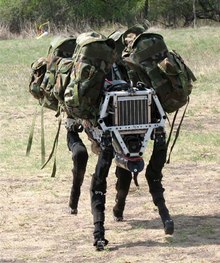
The quadrupedal military robotCheetah, an evolution of BigDog(pictured), was clocked as the world's fastest legged robot in 2012, beating the record set by an MIT bipedal robot in 1989.[1]
A robot is a mechanical or virtual artificial agent, usually an electro-mechanical machine that is guided by a computer program or electronic circuitry. Robots can be autonomous or semi-autonomous and range from humanoids such as Honda's Advanced Step in Innovative Mobility (ASIMO) and TOSY's TOSY Ping Pong Playing Robot (TOPIO) to industrial robots, medical operating robots, patent assist robots, dog therapy robots, collectively programmed swarmrobots, UAV drones such as General Atomics MQ-1 Predator, and even microscopic nano robots. By mimicking a lifelike appearance or automating movements, a robot may convey a sense of intelligence or thought of its own.
The branch of technology that deals with the design, construction, operation, and application of robots,[2] as well as computer systems for their control, sensory feedback, and information processing is robotics. These technologies deal with automated machines that can take the place of humans in dangerous environments or manufacturing processes, or resemble humans in appearance, behavior, and/or cognition. Many of today's robots are inspired by nature contributing to the field of bio-inspired robotics. These robots have also created a newer branch of robotics: soft robotics.
From the time of ancient civilization there have been many accounts of user-configurable automated devices and even automata resembling animals and humans, designed primarily as entertainment. As mechanical techniques developed through the Industrial age, there appeared more practical applications such as automated machines, remote-control and wireless remote-control.
The word 'robot' was first used to denote a fictional humanoid in a 1921 play R.U.R. by the Czech writer, Karel Čapek but it was Karel's brother Josef Čapek who was the word's true inventor.[3][4] Electronics evolved into the driving force of development with the advent of the first electronic autonomous robots created by William Grey Walter in Bristol, England in 1948. The first digital and programmable robot was invented by George Devol in 1954 and was named the Unimate. It was sold to General Motors in 1961 where it was used to lift pieces of hot metal from die casting machines at the Inland Fisher Guide Plant in the West Trenton section of Ewing Township, New Jersey.[5]
Robots have replaced humans[6] in performing repetitive and dangerous tasks which humans prefer not to do, or are unable to do because of size limitations, or which take place in extreme environments such as outer space or the bottom of the sea.
There are concerns about the increasing use of robots and their role in society. Robots are blamed for rising unemployment as they replace workers in increasing numbers of functions.[7] The use of robots in military combat raises ethical concerns. The possibilities of robot autonomy and potential repercussions have been addressed in fiction and may be a realistic concern in the future.
The definition of a sports car is not precise, but from the earliest first automobiles "people have found ways to make them go faster, round corners better, and look more beautiful" than the ordinary models inspiring an "emotional relationship" with a car that is fun to drive and use for the sake of driving.[6] The basis for the sports car is traced to the early 20th century touring cars and roadsters. These raced in early rallys, such as the Herkomer Cup, Prinz Heinrich Fahrt, and Monte Carlo.[7]
Though the term sports car would not be coined until after World War One,[2] the first sports cars are considered to be the 3 litre 1910 Prince Henry (Prinz Heinrich) Vauxhall 20 hp (tax rating) and the 27/80PS Austro-Daimler designed by Ferdinand Porsche.[7]
These would shortly be joined by the French DFP (which became sporters after tuning by H.M. and W. O. Bentley) and the Rolls-Royce Silver Ghost. In the U.S., where the type was variously called roadster, speedster, runabout, or raceabout, there was Apperson, Kissel, Marion, Midland, National, Overland, Stoddard-Dayton, and Thomas among small models, while Chadwick, Mercer, Stutz, and Simplex were among large models.[7]
In 1921, Ballot premiered its 2LS, with a remarkable 75 hp (56 kW) DOHC two liter, designed by Ernest Henry (formerly of Peugeot's Grand Prix program), capable of 150 km/h (93 mph); at most, one hundred were built in four years. This was followed by the SOHC 2LT and 2LTS. The same year, Benz built a supercharged 28/95PS four for the Coppa Florio; Max Sailer won.[7]
Simson in 1924 offered a Paul Henze-designed 60 hp (45 kW) DOHC 2 liter four, the Simson Supra Type S, in a long-wheelbase 120 km/h (75 mph) tourer and 115 km/h (71 mph) twin-carburettor sporter; only thirty were sold, against around three hundred of the SOHC model and 750 of the pushrod-six Type R. Duerkopp's Zoller-blown two liter in 1924, as well.[7]
There was a clear cleavage by 1925. As four-seaters were more profitable, two-seaters increasingly turned over to specialist manufacturers, led by Alvis, Aston-Martin, and Frazer-Nash, with shoestring budgets, fanatic followers, and limited sales (today exemplified by Aston and Morgan): between 1921 and 1939, 350 Astons were built; 323 Frazer-Nashes in the period 1924–39.[7]
By the end of the 1920s, AC produced a 2-liter six, the 3.5 liter Nazzaro had a three-valve OHC (until 1922), while French makers Amilcar, Bignan and Samson, and Franco-Spanish Hispano-Suiza, had the typical small four-cylinder sporters and Delage, Hotchkiss, and Chenard-Walcker the large tourers. Benz introduced the powerful SS and SSK, and Alfa Romeo, the Vittorio Jano-designed 6C.[7]
Hispano-Suiza's Alfonso XIII is considered[by whom?] the first sportcar developed between 1911 and 1914.[citation needed]
Two companies would offer really reliable sports cars: Austin with the Seven and Morris Garages (MG) with the Midget.[citation needed] The Seven would quickly be "rodded" by numerous companies (as the Type 1 would be a generation later), including Bassett and Dingle (Hammersmith, London); in 1928, a Cozette blower was fitted to the Seven Super Sports, while Cecil Kimber fitted an 847 cc Minor engine, and sold more Midgets in the first year than MG's entire previous production.[7]

How Chameleons change colors (Tan Yee Xuan)

If a chameleon's striking ability to change colors seems like a magic act of smoke and mirrors, that's because their skin is quite literally made up of special mirrors, scientists have discovered.
The panther chameleon has tiny crystals under its skin called iridophores that contract or expand when the animal is excited or feels threatened, a new study shows, explaining how the reptile can quickly shift between green, yellow and red.
Depending on the position of the reptile's skin, the crystals then reflect different levels of light that allow the animal to shift colors, according to a study published today in the journal"Nature Communications."
The crystals are arranged in a triangular lattice and are made from guanine, one of the building blocks of DNA, according to the study. Scientists used spectroscopy, the study of the interaction between matter and light, to observe changes in the skin of the reptile species that is native to Madagascar.
What they found was the ability of the chameleon to go from its natural camouflaged green color to red and yellow hues in a matter of two minutes thanks to the efficiently organized crystals. When the animal becomes excited, the crystal lattice stretches, allowing the iridophores to reflect different wavelengths of light.
"They are like selective mirrors," Michel Milinkovitch a co-author of the study at the University of Geneva in Switzerland told the BBC. "Light will bounce on them only for specific wavelengths. ... The other wavelengths will not bounce on these cells."
PHOTO: A new study may reveal how Chameleons change color.

Monday, 23 May 2016

因特网

因特网 (Hu Yajing)

      因特网(Internet)是一组全球信息资源的总汇。有一种粗略的说法,认为INTERNET是由于许多小的网络(子网)互联而成的一个逻辑网,每个子网中连接着若干台计算机(主机)。Internet以相互交流信息资源为目的,基于一些共同的协议,并通过许多路由器和公共互联网而成,它是一个信息资源和资源共享的集合。


Friday, 20 May 2016

This article is about mechanical robots. For software agents, see Bot. For other uses of the term, see Robot (disambiguation).
ASIMO (2000) at the Expo 2005, a bipedal humanoid robot.
Articulated welding robots used in a factory, a type of industrial robot.
The quadrupedal military robotCheetah, an evolution of BigDog(pictured), was clocked as the world's fastest legged robot in 2012, beating the record set by an MIT bipedal robot in 1989.[1]
A robot is a mechanical or virtual artificial agent, usually an electro-mechanical machine that is guided by a computer program or electronic circuitry. Robots can be autonomous or semi-autonomous and range from humanoids such as Honda's Advanced Step in Innovative Mobility (ASIMO) and TOSY's TOSY Ping Pong Playing Robot (TOPIO) to industrial robots, medical operating robots, patent assist robots, dog therapy robots, collectively programmed swarmrobots, UAV drones such as General Atomics MQ-1 Predator, and even microscopic nano robots. By mimicking a lifelike appearance or automating movements, a robot may convey a sense of intelligence or thought of its own.
The branch of technology that deals with the design, construction, operation, and application of robots,[2] as well as computer systems for their control, sensory feedback, and information processing is robotics. These technologies deal with automated machines that can take the place of humans in dangerous environments or manufacturing processes, or resemble humans in appearance, behavior, and/or cognition. Many of today's robots are inspired by nature contributing to the field of bio-inspired robotics. These robots have also created a newer branch of robotics: soft robotics.
From the time of ancient civilization there have been many accounts of user-configurable automated devices and even automata resembling animals and humans, designed primarily as entertainment. As mechanical techniques developed through the Industrial age, there appeared more practical applications such as automated machines, remote-control and wireless remote-control.
The word 'robot' was first used to denote a fictional humanoid in a 1921 play R.U.R. by the Czech writer, Karel Čapek but it was Karel's brother Josef Čapek who was the word's true inventor.[3][4] Electronics evolved into the driving force of development with the advent of the first electronic autonomous robots created by William Grey Walter in Bristol, England in 1948. The first digital and programmable robot was invented by George Devol in 1954 and was named the Unimate. It was sold to General Motors in 1961 where it was used to lift pieces of hot metal from die casting machines at the Inland Fisher Guide Plant in the West Trenton section of Ewing Township, New Jersey.[5]
Robots have replaced humans[6] in performing repetitive and dangerous tasks which humans prefer not to do, or are unable to do because of size limitations, or which take place in extreme environments such as outer space or the bottom of the sea.
There are concerns about the increasing use of robots and their role in society. Robots are blamed for rising unemployment as they replace workers in increasing numbers of functions.[7] The use of robots in military combat raises ethical concerns. The possibilities of robot autonomy and potential repercussions have been addressed in fiction and may be a realistic concern in the future.